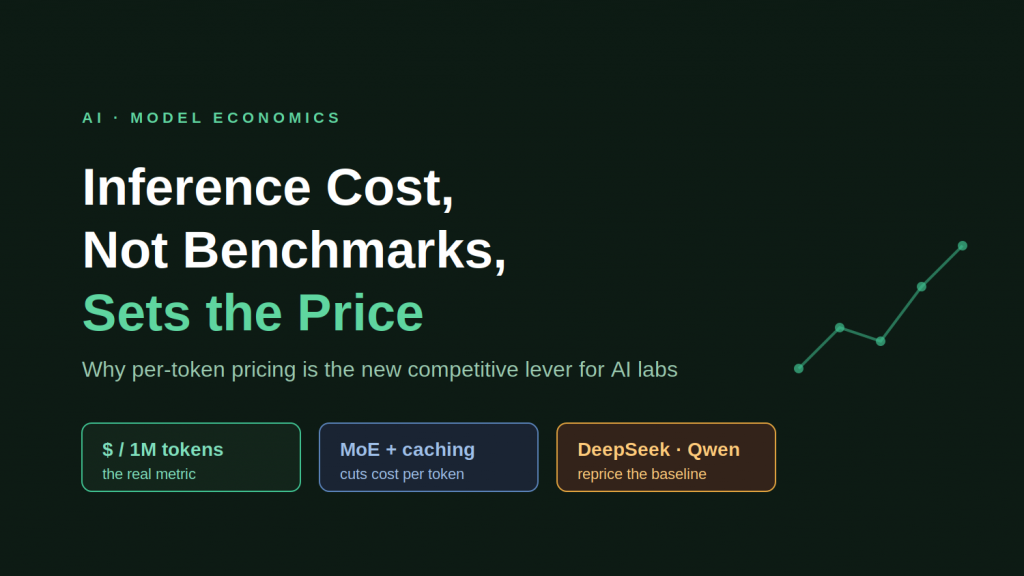
Inference Cost Is Determining the Pricing Strategy of AI Labs, Not Benchmarks
As capability gaps between frontier models narrow, inference cost and per-token pricing—not benchmark scores—are shaping the pricing strategies of AI labs.
Refusal rate and failure modes in a model card determine whether a model is usable in production more than any benchmark score does.
DeepSeek and Qwen are pushing inference costs down to levels that are forcing Western labs to reposition their pricing, even though a reasoning gap remains in some categories.
Test-time compute lets models reason for longer to improve accuracy on certain benchmarks, but it trades off latency and cost, and the gains are uneven across tasks.
Agentic AI works in scripted demos. Running tool-using agents in production exposes compounding error, cost, and latency problems that single-turn benchmarks never measured.
Top frontier models from OpenAI, Anthropic, Google, and Meta now cluster within a few benchmark points. The real differences are cost, context reliability, and failure modes.
OpenAI's GPT-5.1 claims a 1M-token context window and 40% lower inference cost, but independent benchmarks and architecture details are absent at launch.
OpenAI's GPT-5.1 claims a 1M-token context window and 40% lower inference cost than GPT-5, but independent eval data to verify the reasoning gains is still pending.
A smoke-test run with no source data. No model, benchmark, or cost figures to report. This piece validates the publishing pipeline, not any AI product.