Agentic AI Moves From Demo to Deployment, But Tool-Use Reliability Still Lags Behind the Pitch
Agentic AI works in scripted demos. Running tool-using agents in production exposes compounding error, cost, and latency problems that single-turn benchmarks never measured.
Agentic AI, systems that chain multiple reasoning steps and call external tools to complete tasks without a human in the loop, has dominated vendor roadmaps through 2024 and into 2025. OpenAI, Anthropic, and Google have all shipped agent frameworks built on their flagship models, and OpenAI's GPT-5.1 line continues the push toward longer context windows and more reliable function calling. The gap that matters now is not whether an agent can complete a task once in a demo, but whether it can do so repeatedly under production conditions.
What agentic systems actually do differently
A conventional chat model produces one response per prompt. An agentic system runs a loop: it reads a goal, decides on an action (often calling a tool such as a search API, a code interpreter, or a database query), reads the result, and decides on the next action. This continues until the model judges the task complete or hits a step limit.
The capability that unlocks this is structured tool-use, sometimes called function calling. The model emits a structured request specifying which tool to invoke and with what arguments, the runtime executes it, and the output is fed back into context. The reliability of that emit-execute-read cycle, not raw reasoning ability, is what determines whether an agent finishes a ten-step task or derails at step four.
Larger context windows help here because an agent accumulates state across steps. Every tool call, every intermediate result, and every reasoning trace consumes tokens. A context window that holds a long task history reduces the need for summarization, which is itself a source of error. This is why context window size has become a headline spec for agent-oriented models rather than just a convenience for long documents.
Why demos and deployments diverge
A demo is a single successful trajectory. Deployment is a distribution of trajectories, and the tail of that distribution is where agents break. The standard single-turn benchmarks the industry quotes, the ones measuring knowledge, reasoning, or code generation, do not capture compounding error. If a model picks the correct action 95 percent of the time at each step, a ten-step task succeeds only about 60 percent of the time, because errors multiply across the chain.
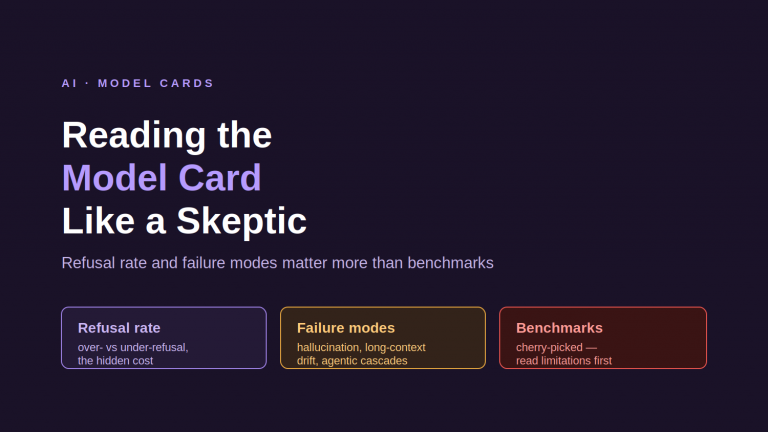
The failure modes are specific and recurring. Agents hallucinate tool arguments, passing parameters that do not exist or are malformed. They loop, repeating the same failed action because they cannot reason about why it failed. They lose track of the original goal during long trajectories, a problem that worsens as context fills. And they handle ambiguous tool outputs poorly, treating an empty result or an error message as if it were valid data.
None of these show up cleanly in a leaderboard number. Agent-specific evaluations attempt to measure them, but the field still lacks standardized, widely trusted benchmarks for multi-step tool-use reliability the way HumanEval or GPQA standardize their respective domains. That makes vendor reliability claims hard to verify independently, which is reason for caution rather than dismissal.
The cost and latency problem
Agentic loops are expensive. A task that would take one inference call in a chat setting can take a dozen or more in an agent, each consuming input and output tokens, with context growing at every step. Inference cost scales with the length of the accumulated trajectory, so a long-running agent can cost an order of magnitude more than a single completion for the same nominal task.
Latency compounds the same way. Each tool call adds the model's inference time plus the external tool's execution time, and these run sequentially when later steps depend on earlier results. A task that a user expects to complete in seconds can take a minute or more. For interactive products this is a usability ceiling, not just a cost line item.
What this means for Asia-Pacific builders
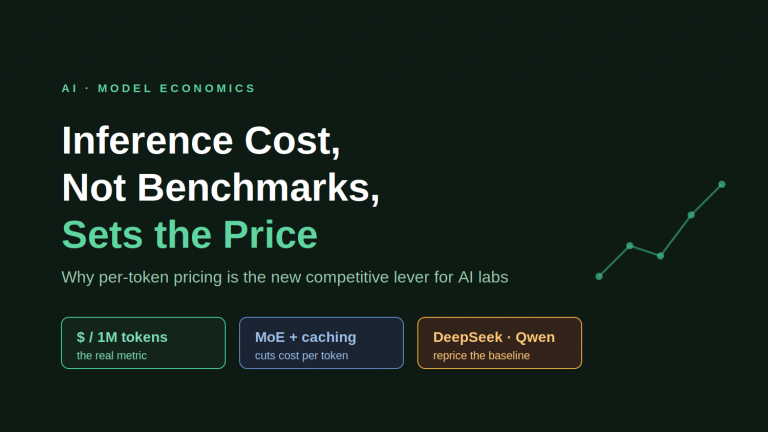
For developers and startups across the region, the practical question is which model to build agents on, and the answer increasingly includes options outside the US labs. DeepSeek and Alibaba's Qwen line have released models with competitive function-calling support at lower published inference costs, which matters disproportionately for agentic workloads where token consumption multiplies. A model that is slightly weaker per step but markedly cheaper can be the rational choice for a high-volume agent, provided its reliability holds across the chain.
Teams shipping agents in production tend to converge on the same engineering discipline regardless of which model they choose: constrain the tool set, validate every tool argument before execution, cap the number of steps, and add deterministic fallbacks for the cases the model gets wrong. The agent does less open-ended reasoning and more execution within tight guardrails. That is less impressive than an autonomous demo, and it is closer to what currently works.
The trajectory is real. Tool-use reliability has improved across model generations, and longer context windows make stateful agents more practical than they were a year ago. The honest read is that agentic AI is past proof-of-concept and into narrow, well-scoped production use, while the fully autonomous general-purpose agent remains a target rather than a shipped product.