Ecosystem Lock-In: Apple, Samsung, Google and the Cost of Leaving
Apple locks you in through experience, Samsung through layered services, Google through data. Which one holds you the tightest, and what does leaving cost?
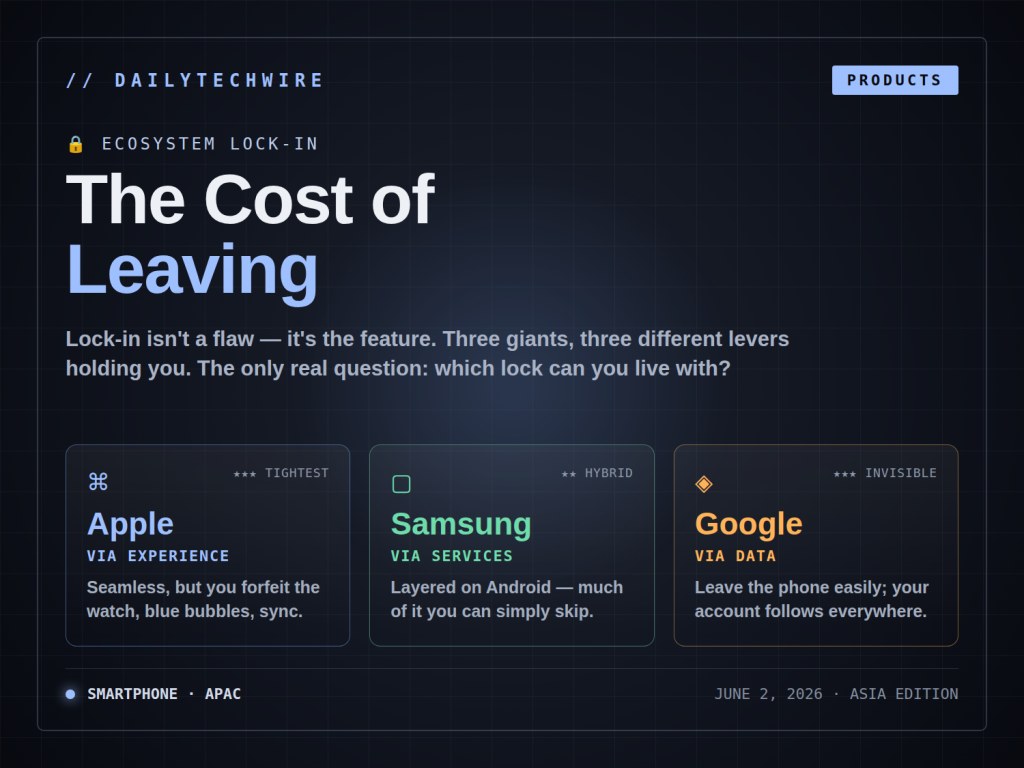
Lock-in isn’t a design flaw. It’s a feature, and all three companies do it on purpose. The difference lies in which lever each one uses to keep you, and what you lose if you switch to another platform.
The short verdict first: Apple locks you in the tightest, but in exchange offers a markedly seamless experience. Samsung locks you in through hardware and a layer of services stacked on top of Android, partly removable. Google locks you in the loosest on devices but the heaviest on data, because your account follows you across every platform. Choosing wrong can leave you paying for years for something you no longer want to use.
Apple: lock-in through experience, not just data
Apple doesn’t need to force you. They make staying more pleasant than leaving. iMessage, FaceTime, AirDrop, Handoff, the Apple Watch that only pairs with an iPhone, AirPods that switch devices instantly within the same account. Each individual feature is small. Added together, they create real friction the moment you want to pick up an Android.
Apple’s exit cost is the highest, but most of it is an experience cost rather than a cash one. You lose the blue chat group, lose message sync with your Mac, lose the perfectly good Apple Watch because it’s useless on Android. Apps you bought on the App Store don’t transfer to the Play Store, though most popular apps offer a free re-login version.
A point worth crediting: Apple rarely forces upgrades by dropping support early. iPhones typically receive iOS updates for five or six years, longer than the Android norm. Lock-in here comes with genuine software longevity, so for many people it isn’t purely a trap.
Samsung: hybrid lock-in, half removable
Samsung sits in the hardest position to define. They run Android, so in theory you’re freer, but they layer their own stack on top: Samsung Account, Samsung Cloud, SmartThings, Samsung Pay, Galaxy Wearable, Bixby, Knox. Galaxy Buds work most fully with a Galaxy phone. The Galaxy Watch loses many features when paired with another brand’s Android phone and is nearly useless on an iPhone.
The big difference from Apple: most of Samsung’s lock-in is services you can skip. You can sign in with Google instead of a Samsung Account, use Google Photos instead of Samsung Cloud, remove Bixby from the power button. Someone who buys a Galaxy just to take photos and browse the web is barely locked into anything. Only deep Samsung-ecosystem users, especially the foldable-plus-SmartThings-plus-watch combo, feel friction when leaving.
The real trade-off here is updates. Samsung now commits to seven years of updates for its flagship line, on par with Google and close to Apple. But the mid-range still has a much shorter lifecycle, so your lock-in depends on which phone you buy.
Google: free devices, captive data
Google locks you in at the layer you pay the least attention to. You can switch from Pixel to Samsung to iPhone with almost no device-level loss, because Gmail, Google Photos, Drive, Maps, and YouTube all run everywhere. That’s exactly the problem. It’s your Google account that’s locked in, not your phone.
Years of photos on Google Photos, your Maps history, Drive documents, passwords in Chrome create a gravitational pull that isn’t tied to hardware. You leave a Pixel easily. Leaving your Google account is another matter entirely, and Google knows it. This is the most durable kind of lock-in because it’s invisible in everyday use.
On devices, the Pixel now gets seven years of updates, putting it on par with Apple for software longevity. But Google’s hardware ecosystem is thin: the Pixel Watch, Pixel Buds, no genuinely competitive consumer laptop. You’re not held by a network of devices, you’re held by data.
Which lock-in to choose
No company is truly free, so the right question is which kind of lock you can live with.
If you already have a Mac, an iPad, or several family members on iPhones, the cost of leaving Apple is so high that deliberating is almost pointless, and that ecosystem runs the smoothest. If you like hardware customization, foldable screens, and are willing to skip Samsung’s own services, Galaxy gives you lighter lock-in than it first feels. If you change phones often and want device flexibility, a Pixel or any Android phone using a Google account is the least binding choice on hardware, as long as you accept that your data lives in Google’s garden.
A note for users in Asia: the practical calculation also depends on local services. iMessage is nearly irrelevant in markets dominated by WhatsApp, LINE, or KakaoTalk, which significantly reduces Apple’s lock-in. Samsung Pay and some Galaxy services have uneven support by country. An ecosystem that’s strong on paper can be far weaker depending on where you live.
Lock-in is only a problem when you want to leave. Before buying your next one, it’s worth asking yourself: over the next five years, what will make me hardest to pull away, and am I okay with that.