GPT-5.1 Review: Larger Context Memory, But Who’s the Upgrade Worth It For?
GPT-5.1 expands the context window and fine-tunes speed. It's worth the upgrade for devs handling long documents, but casual users don't need to switch just yet.
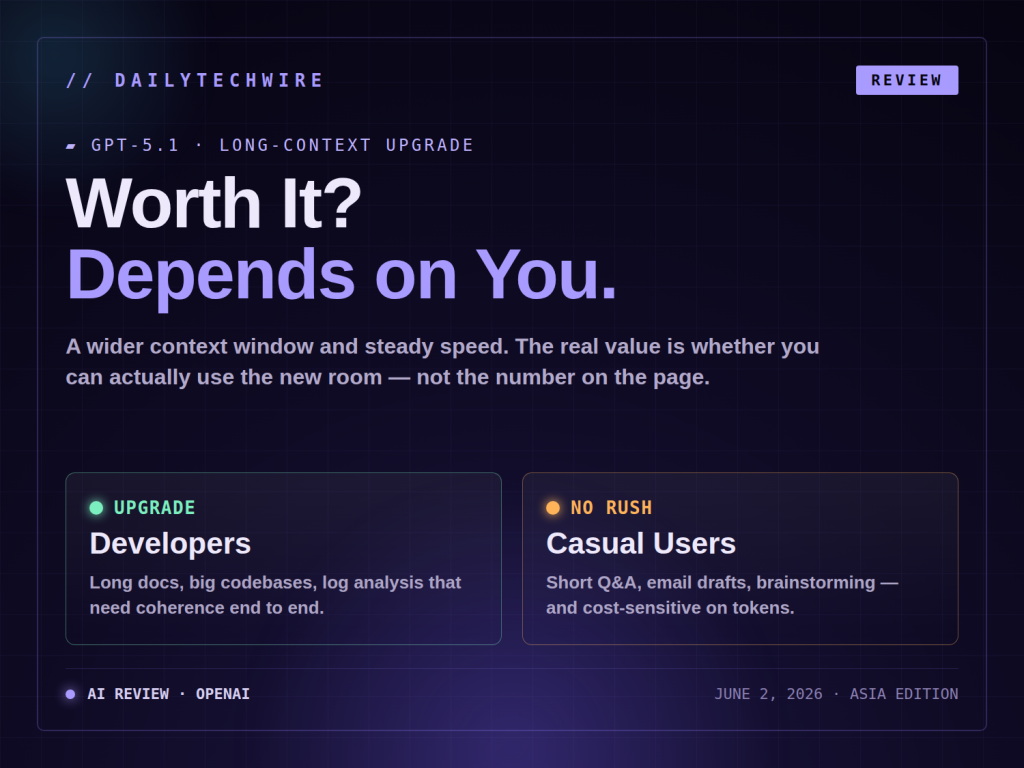
Verdict first: if you’re a developer who regularly pushes large codebases or documents dozens of pages long into a single prompt, GPT-5.1 is an upgrade worth considering thanks to its wider context window. If you only use it for short Q&A, drafting emails, or brainstorming, the difference from the previous version is thin enough that it’s hard to justify switching paid plans right away.
The main selling point of GPT-5.1 that OpenAI emphasizes is the expanded context window—the amount of text the model can “read” and hold within a working session before it starts forgetting the beginning as it processes the end. This is a real pain point for anyone working with long documents: previously you had to chop contracts, error logs, or book chapters into multiple segments and stitch the results together by hand. A larger context significantly reduces that manual work.
Strengths in real-world use
For long-document synthesis tasks, the model’s ability to maintain coherence is the most noticeable difference. When you feed in a set of technical documents and ask it to trace a detail that appeared near the beginning, the model holds onto context better—subjectively speaking—than the previous generation. This is useful for code review, analyzing long logs, or cross-referencing multiple versions of a text.
Response speed with short prompts is stable, with no long waits for ordinary questions. This is an ergonomics factor that’s easy to overlook but directly affects the daily experience: a model that’s smart but sluggish to respond will break your workflow.
Trade-offs to know
A large context window isn’t free in terms of cost. Pushing a large number of tokens into each turn means your API costs or your paid plan’s usage limits get consumed faster. Users need to weigh the convenience of “cramming everything into one prompt” against the actual costs incurred.
In addition, a large context doesn’t equate to absolute accuracy across the entire content. When a document reaches the threshold of length, the quality of detail retrieval in the middle of a passage is still something to verify for each use case—you shouldn’t assume by default that the model accurately remembers everything you put in.
Compared to options in the same tier
GPT-5.1 isn’t the only choice for those who need a long context. Rival models compete head-on in this area, and the decision should be based on the ecosystem you’re already using rather than a single context number. If your workflow is already tightly tied to OpenAI’s tools and API, staying makes sense. If not, this isn’t a strong enough reason to lock yourself into one ecosystem.
The Asian context
In the Asia-Pacific market, the deciding factors are usually server latency, native language support, and plan pricing converted to local currency. Developers in the region should test the quality of local-language processing in long documents before committing, since performance in English doesn’t always reflect the true multilingual experience.
Who should buy it
Worth upgrading if: you regularly work with long documents, code, or data and need the model to maintain coherence throughout. No rush if: your needs are short conversations and basic drafting, and you’re sensitive to token costs. As with any model upgrade in a fast-maturing category, the real value depends on whether you can actually exploit the new features—not on the number itself on the marketing page.