Health sensors on wearables: what they measure, and how much you should trust them
Heart rate on wearables is good enough for training, but SpO2, blood pressure, and stress scores are still far from medical-grade reliability. How to read the numbers without being led astray by marketing.
Before you spend money on a smartwatch or fitness band because it promises to measure blood oxygen, ECG, or stress, here’s the short verdict: some sensors are good enough for tracking daily trends, while others are closer to a novelty feature than a medical tool. The problem isn’t that the device lies—it’s the gap between “measuring a number” and “that number being reliable enough to act on.”
Heart rate: the most trustworthy sensor, but with conditions
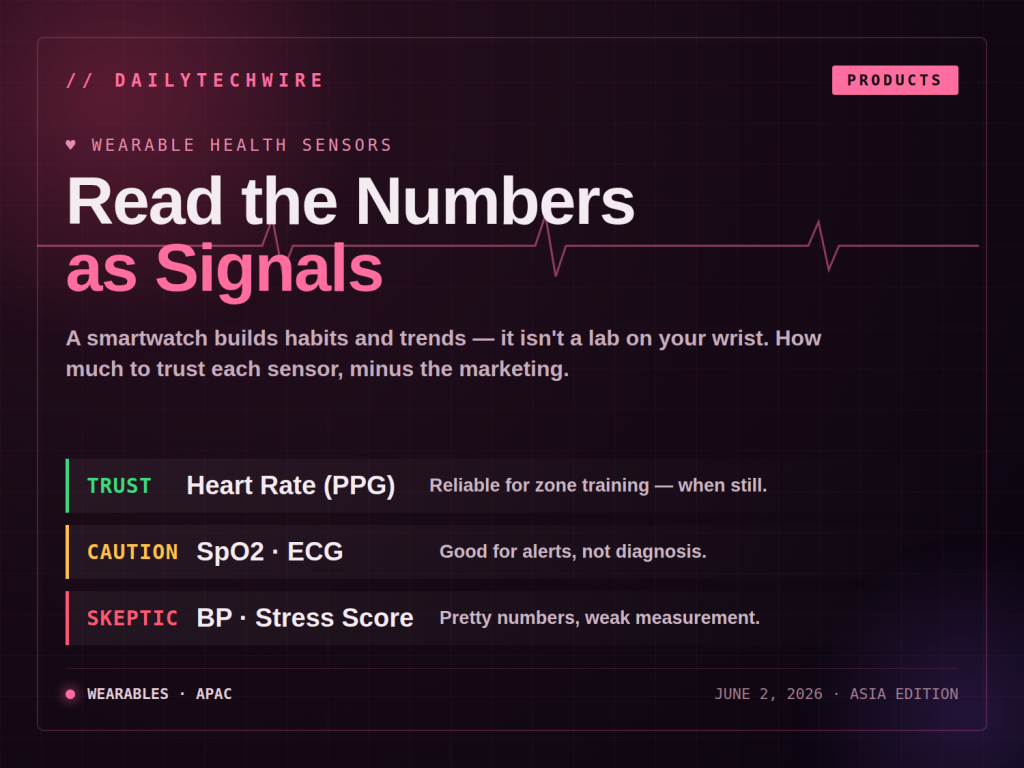
Optical heart rate measurement (PPG, using LEDs shining through the skin to detect your pulse) is the most mature technology on wearables. When you sit still or run at a steady pace, the number usually tracks reality closely enough to use for zone training. Problems show up with sudden movements: interval training, lifting weights with bent wrists, or cold weather that constricts blood vessels. In those situations, a wrist sensor easily lags or misreads. If you train seriously and need accuracy down to the second, a chest strap is still the better choice, no matter how expensive the watch is.
The real trade-off: the strap’s build quality and how snugly it fits your wrist affect accuracy more than people think. Wearing it loose, wearing it over the wrist bone, or sweaty skin all introduce signal noise. This is a daily pain point that few reviews mention.
SpO2 and ECG: good for alerts, not diagnosis
Blood oxygen sensors (SpO2) and single-lead ECG measurement are where marketing tends to go further than actual capability. Some watches with ECG functionality have been cleared by regulators in the US and Europe as tools for detecting arrhythmias (mainly atrial fibrillation), but that’s screening, not diagnosis. Wrist SpO2 fluctuates considerably with posture and blood flow, so a single low reading in the middle of the night doesn’t tell you much.
The real value of these sensors lies in their ability to prompt you to see a doctor, not to replace the visit. That’s an important distinction the spec sheet never spells out.
Blood pressure and “stress score”: be wary of pretty numbers
Cuffless blood pressure measurement on wearables is still an immature field. Most methods rely on indirect estimation and need periodic calibration with a traditional monitor. Skip the calibration step, and the number tends to drift over time.
Metrics like “stress,” “body battery,” or “readiness” are even further removed from physical measurement. They’re usually algorithms inferred from heart rate variability (HRV) plus a set of assumptions. They can be useful as a rough signal of trends, but don’t treat a score of 73/100 as a fact.
So where does the real value lie
The true strength of wearables isn’t the absolute accuracy of any single measurement—it’s continuity. Tracking the same metric every day on the same device gives you a personal baseline, and the change relative to that baseline is what carries valuable information. A resting heart rate creeping up over the course of a week says more than a single isolated SpO2 reading.
This leads to a piece of advice about value: a mid-range device you wear every day, with real-world battery life good enough that you’re not constantly charging it, is more useful than a high-end device packed with sensors that sits in your drawer. Which sensor you actually use matters more than which sensor is on the box.
Asia context
In the Asia-Pacific market, buyers have plenty of options from brands like Xiaomi, Huawei, and Amazfit in the low-to-mid price segment, often significantly cheaper than an Apple Watch or Garmin for the same basic set of sensors. The real difference lies less in the PPG hardware (which is largely comparable) than in algorithm quality, app ecosystem, and which features local regulators allow to be enabled. Some ECG or heart-rate alert functions may be restricted depending on the region, so check before buying if that’s the reason you’re choosing the device.
Verdict: buy a wearable to build habits and read trends, not to have a lab on your wrist. Read the numbers as signals, not conclusions, and you’ll avoid most of the disappointment.