Comparing Electric Vehicles in the Asian Market: BYD, Tesla, VinFast and the Question of Real Value
The EV segment in Asia has matured. Comparing BYD, Tesla, and VinFast by real-world trade-offs: local pricing, charging infrastructure, and ownership value—no star ratings
If you’re in Singapore, Bangkok, Jakarta, or Hanoi and considering your first electric vehicle, the short answer is this: there’s no single “best car” for the entire region. Asia’s EV market has fragmented enough that each price tier has its own reasonable choice, and the decision depends far more on the charging infrastructure in your country than on a manufacturer’s spec sheet.
This article doesn’t assign star ratings. It lays out the real-world trade-offs between the vehicle groups actually selling in the region, so you know what you’re giving up in exchange for what.
Market context: why Asia differs from the rest of the world
Unlike the US or Europe, the APAC market is heavily shaped by Chinese manufacturers and domestic brands. In many Southeast Asian countries, the price buyers actually pay differs significantly from the manufacturer’s list price, due to import tax policies, country-specific EV incentives, and road fees. A car that’s “cheap” in one market can be 30 to 50 percent more expensive in a neighboring one. This is the first variable to check before comparing specs.
The second factor is charging infrastructure. Brochure range is almost meaningless if your country lacks a network of DC fast chargers along its highways. For urban users who park in apartment buildings without home charging, real-world battery life and recharging speed matter more than the maximum range figure.
The mass-market segment: where the price war is fiercest
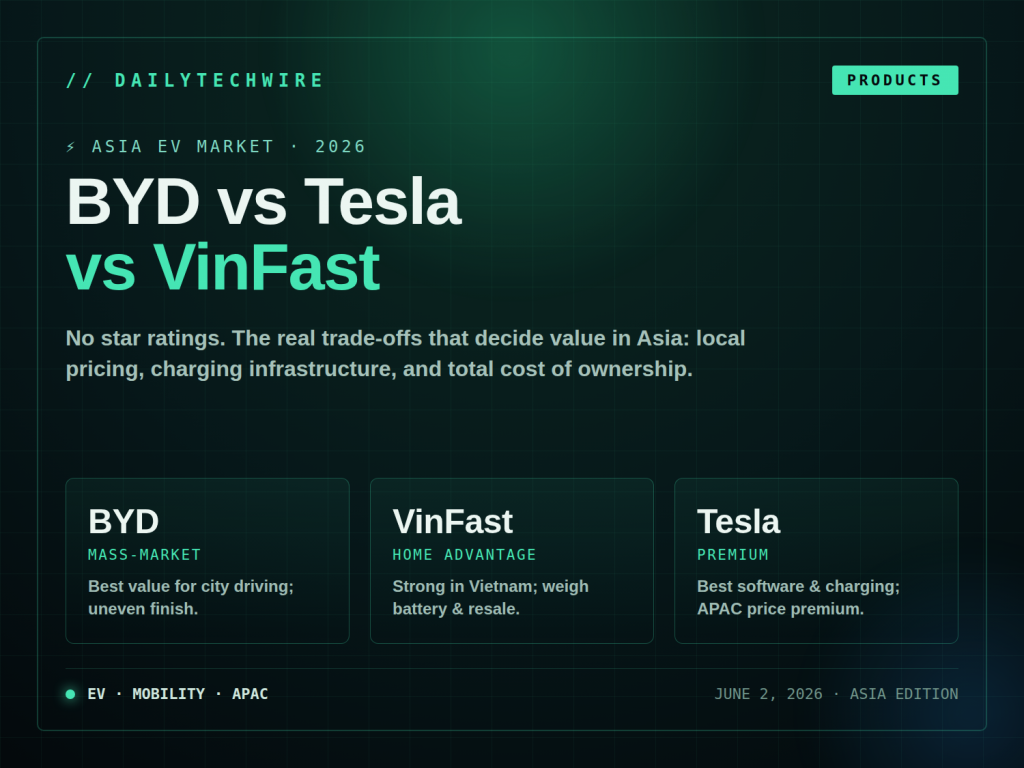
In the low to mid price range, models from BYD and several other Chinese manufacturers are redefining expectations. Common strengths: range that’s sufficient for city use, more comfort features than gas cars at the same price, and distribution networks expanding rapidly in Thailand, Indonesia, and Vietnam.
Trade-offs to keep in mind: build quality and interior finish in this segment are uneven across models. In-car software (infotainment, driver-assist systems) is sometimes poorly localized for markets outside China. This is a group worth considering if you prioritize value for money and mostly drive in the city.
VinFast and the domestic brand story
VinFast is a notable case in the Asian context. As a Vietnamese brand, it has a home-field advantage in pricing and after-sales service within Vietnam, while expanding into regional markets. What buyers should realistically weigh: long-term durability and resale value of a young brand remain question marks, since its operating history isn’t long enough to yield reliable durability data. The battery leasing model used during certain periods also changes the ownership cost equation significantly, so it’s worth carefully calculating total cost rather than just looking at the vehicle price.
The premium segment: Tesla and the ecosystem question
Tesla remains a strong choice in markets with good charging infrastructure like Singapore, thanks to its Supercharger network and stable software. In return, prices in APAC are typically considerably higher than in the US, and you accept a certain degree of ecosystem lock-in. For users who value software, OTA updates, and a seamless charging experience, this is a plus. For someone who just needs a car to get around, the price premium is hard to justify.
Verdict: choose by where you live, not by a ranking
No recommendation makes sense divorced from local pricing and infrastructure context. The pragmatic principles:
If you’re in a city with home charging and a limited budget, a mass-market model from BYD or a domestic brand offers the best value.
If you’re in Vietnam and prioritize home-market after-sales service, VinFast is worth shortlisting—but factor in total cost of ownership, including the battery.
If you’re in a market with good charging infrastructure and treat software as a priority, Tesla still holds its value, provided you accept APAC pricing.
The most important thing before you spend: check the price buyers actually pay in your own country, and take a test drive to feel the ergonomics and software quality. A spec sheet won’t tell you those things.