Test-Time Compute: How the New Reasoning Approach Trades Latency for Accuracy
Test-time compute lets models reason for longer to improve accuracy on certain benchmarks, but it trades off latency and cost, and the gains are uneven across tasks.
Test-time compute—the technique of allocating additional computational resources at inference time rather than scaling only during training—has become a central axis of competition among the major AI labs over the past year. The core idea is simple: let the model produce a longer reasoning trace, explore multiple lines of inference, and then select the best answer, in exchange for higher latency and inference cost.
Mechanically, this approach differs from increasing parameter count. A model can keep its weights unchanged but be configured to spend more tokens on chain-of-thought before answering. OpenAI, Google DeepMind, and several other labs have commercialized variants of this idea as toggleable “reasoning” modes, often accompanied by an option to adjust how much compute the user is willing to pay for.
Where it improves, and where it doesn’t
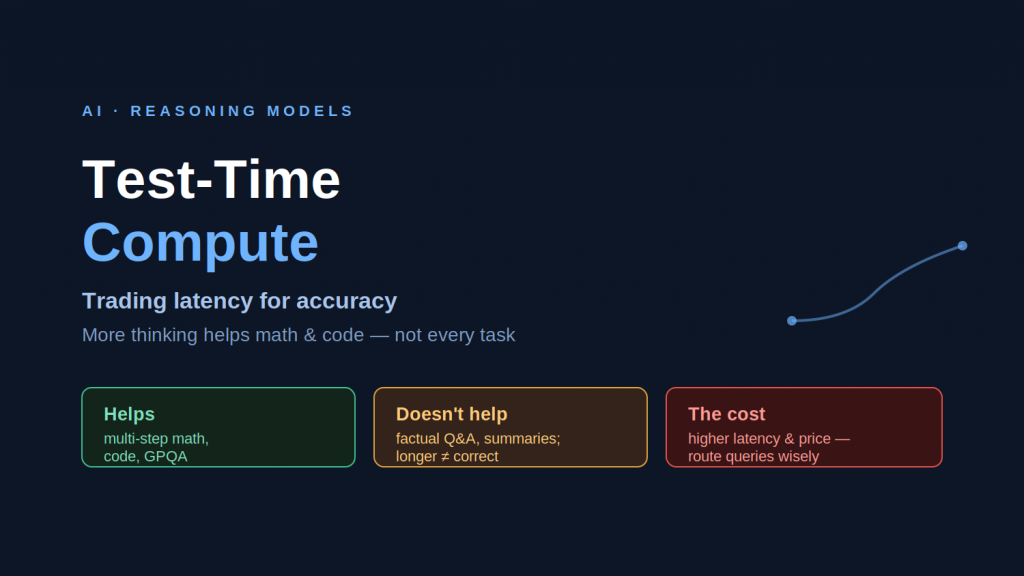
The key distinction is the type of task. On benchmarks that require multi-step reasoning—especially math and programming—extending the reasoning trace usually raises accuracy in a measurable way. This is why evaluations on sets like GPQA or competition math sets often show a clear gap between reasoning mode on and off.
But this benefit is uneven. For tasks that depend on factual knowledge rather than reasoning—simple Q&A or summarization, for example—adding compute at inference rarely helps and sometimes only increases answer length without improving quality. A longer reasoning trace cannot patch a gap in data the model never learned.
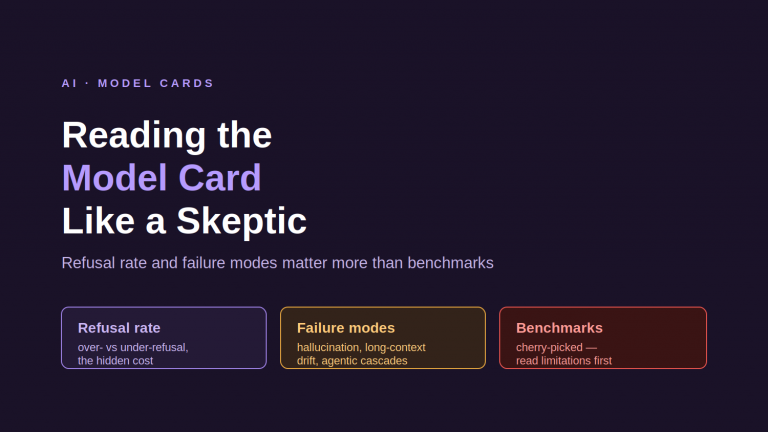
More importantly, a long reasoning trace does not automatically mean correct reasoning. A model can still produce a chain of inference that looks plausible but leads to a wrong conclusion, and extending the chain sometimes amplifies a flawed assumption made at the outset. The hallucination rate doesn’t disappear just because the model “thinks” longer; it changes form.
The cost: cost and latency
The most obvious trade-off lies in cost. When each query consumes more output tokens to serve internal reasoning, inference cost per answer rises accordingly, and latency can go from a few seconds to tens of seconds. For real-time interactive applications, this delay is a practical barrier, not just a line on a pricing sheet.
This creates a concrete engineering problem for implementers: query routing. Not every request needs reasoning mode. A sensible architecture typically separates out complex tasks to send to the high-compute path, while keeping most traffic in the fast, cheap mode. This choice directly affects throughput and operating cost.
A perspective for developers in Asia
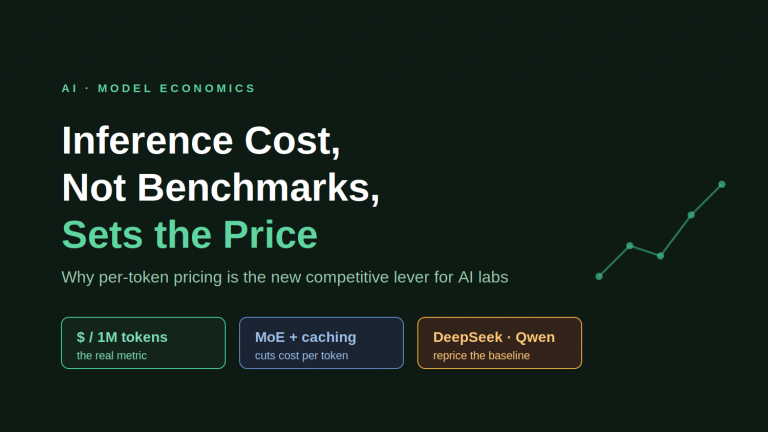
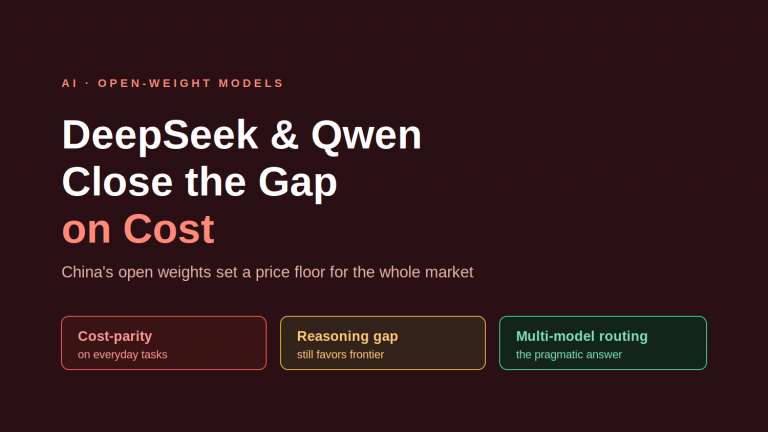
For startups and developers in the region, where inference budgets are often tighter than at U.S. companies, test-time compute raises a clear question about the value-to-cost ratio. Open-weight models from China—such as the DeepSeek line with its reasoning variant, and Qwen—have introduced self-hostable options that allow control over compute cost rather than dependence on the per-token pricing of commercial APIs.
This is worth weighing: for some reasoning-heavy workloads, running a reasoning-capable open-weight model on your own infrastructure may be cheaper in the long run than calling the reasoning-mode API of major providers, in exchange for the engineering cost of operating it.
The practical conclusion is much more modest than the amount of attention the topic receives: test-time compute is a useful tool for a specific class of problems, not an across-the-board upgrade. Evaluation should rest on benchmarks that match your actual task, not the highest number a lab publishes.