Inference Cost Is Determining the Pricing Strategy of AI Labs, Not Benchmarks
As capability gaps between frontier models narrow, inference cost and per-token pricing—not benchmark scores—are shaping the pricing strategies of AI labs.
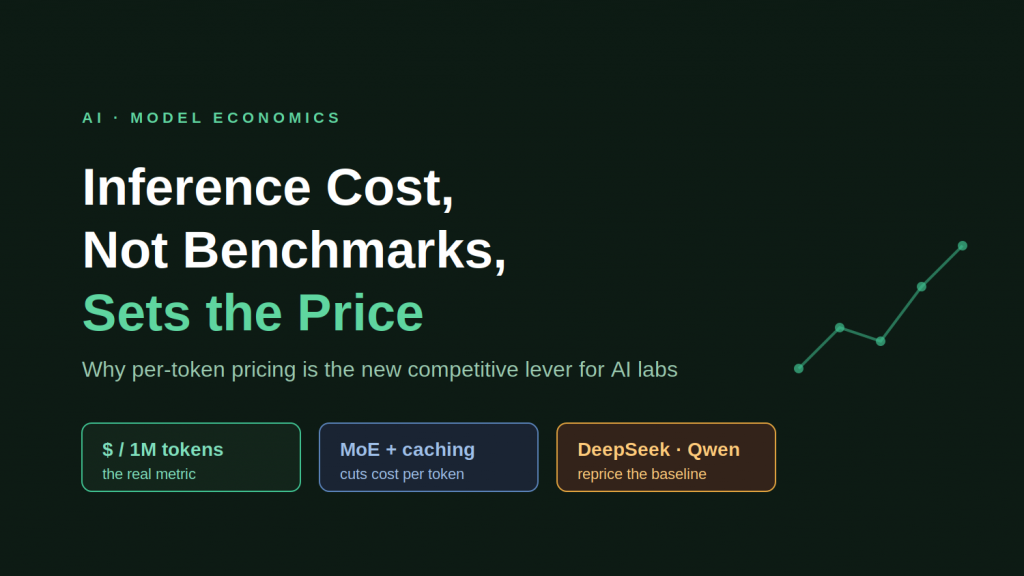
With every new release cycle, AI labs announce higher benchmark scores, yet the factor increasingly shaping developer choices is inference cost: the price of serving a million input and output tokens. As capability gaps between frontier models narrow, pricing becomes a clearer competitive lever than a few percentage points on MMLU or GPQA.
Pricing becomes the main competitive front
A model may lead on HumanEval or GPQA, but if its per-token price is many times higher than rivals’, that advantage is hard to translate into real-world deployment. Most production workloads—from customer support chatbots to RAG pipelines—don’t need top-tier chain-of-thought capability for every request. For these use cases, developers optimize for cost and latency, not eval scores.
This explains why labs tier their products. A flagship model serves complex agentic tasks and heavy test-time compute, accompanied by smaller variants (often created through distillation) with much lower per-token prices and higher throughput. The same brand, but the price-performance curve is stretched to cover multiple budget segments.
Long context windows push the cost problem in a new direction
Expanding the context window, often marketed as a capability feature, is in fact an economic problem. Attention cost grows with context length, so a 200,000-token prompt is far more expensive than a prompt of a few thousand tokens, even when the per-token price stays the same. Labs respond with prompt caching, charging cached tokens at a cheaper rate to encourage patterns that repeat long system prompts.
The Mixture-of-Experts (MoE) architecture is part of the answer on the supply side. By activating only a fraction of parameters per token, MoE reduces inference cost per token compared to a dense model of equivalent capacity. This is why many models with large parameter counts can still be priced competitively: the real cost is tied to the number of active parameters, not the total.
Chinese labs reprice the baseline
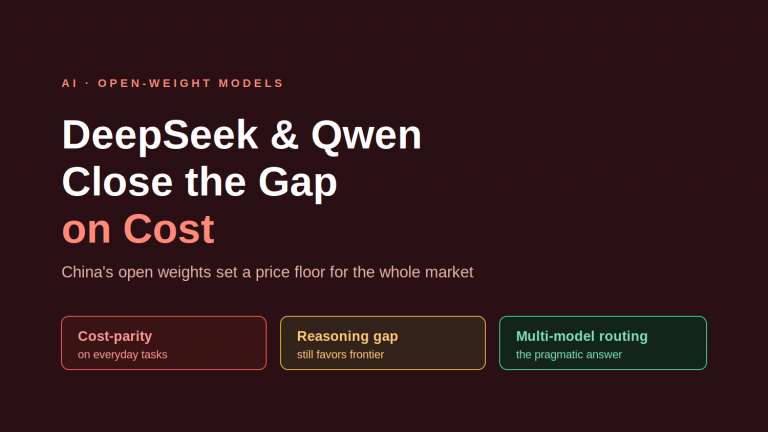
The clearest price pressure comes from Chinese labs. Releases from DeepSeek and Alibaba’s Qwen line have shown that open-weight models can achieve eval scores close to closed systems, while allowing self-hosting or API access at significantly lower prices. When an open-weight model can run on a developer’s own infrastructure, the cost variable shifts from API price to GPU and operational engineering costs.
This puts closed labs in a position where they must justify their premium with things beyond raw benchmark scores: stability of hallucination rates, tooling quality, guarantees on rate limits and uptime, and safety features proven with data rather than marketing.
Implications for developers and startups in Asia
For teams in the region, this tiering widens the space of options but also complicates architectural decisions. A startup can route simple requests to a cheap small model or a self-hosted open-weight model, and send only the tasks that truly require high reasoning capability to an expensive flagship. This difficulty-based routing approach often optimizes total cost better than committing to a single model.
The choice between a closed API and self-hosted open-weight has no universal answer. It depends on request volume, latency requirements, internal GPU operational capacity, and data constraints. The key takeaway is that published benchmarks are increasingly less useful as a sole selection criterion; per-token price, caching behavior, and throughput characteristics under real load are the numbers that decide.