OpenAI Releases GPT-5.1 With 1M-Token Context and Lower Inference Cost
OpenAI's GPT-5.1 claims a 1M-token context window and 40% lower inference cost, but independent benchmarks and architecture details are absent at launch.
OpenAI has released GPT-5.1, an update the company positions around two claims: a context window of up to 1 million tokens and a roughly 40% reduction in inference cost compared with its predecessor. Both figures come from OpenAI's own announcement and have not yet been confirmed by independent evaluation.
The headline change is the context window. A 1M-token ceiling, if it holds in practice, would let the model ingest large codebases, long document sets, or extended multi-turn sessions in a single pass without retrieval workarounds. The relevant question is not the maximum number but whether retrieval accuracy stays stable across the full window. Long-context models have historically degraded in the middle of very large inputs, and OpenAI has not published a needle-in-a-haystack style eval to address that. Until those numbers appear, the 1M figure describes capacity, not reliable recall.
What the cost claim implies
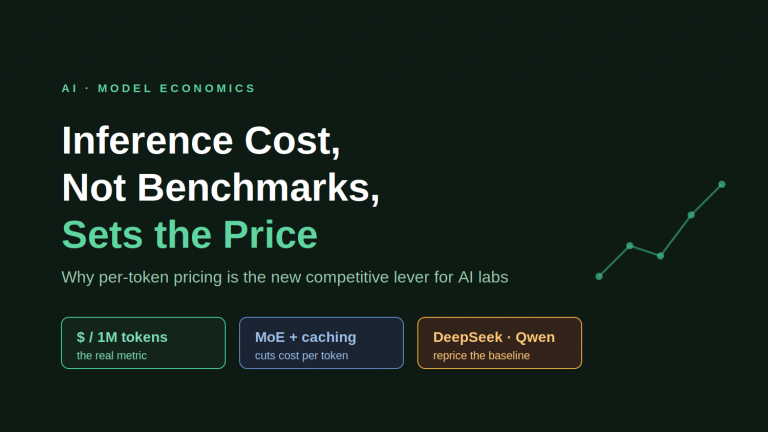
The stated 40% drop in inference cost is the more consequential number for anyone running production workloads. Lower inference cost typically traces to one of a few things: a more efficient serving stack, a mixture-of-experts (MoE) routing scheme that activates fewer parameters per token, or distillation into a smaller model that preserves most of the quality. OpenAI did not disclose parameter count, architecture details, or which mechanism drives the saving, so the reduction has to be read as a pricing-page claim rather than an architectural one.
For teams whose budgets are dominated by token volume rather than per-call latency, a sustained 40% reduction would change the unit economics of agentic pipelines and high-throughput batch jobs. That assumes the cost cut applies across both input and output tokens and is not limited to a single tier.
Competitive positioning
GPT-5.1 enters a field where long context is no longer a differentiator on its own. Google's Gemini line has shipped million-token context, and Anthropic's Claude family has pushed extended windows with its own long-context evals. The competition has shifted from window size to two harder metrics: recall quality at length, and cost per useful token. On both, GPT-5.1 will be judged by independent benchmarks such as MMLU, GPQA, and HumanEval results from third parties, none of which were available at the time of writing.
Limitations to watch
OpenAI's announcement did not include a hallucination rate, a long-context retrieval benchmark, or rate-limit details for the 1M-token tier. Large context windows also raise practical questions about latency and throughput: processing a million tokens per request is computationally heavy, and the per-request latency at full context length matters as much as the token price. None of these were quantified at launch.
The Asia angle
For developers and startups across Asia-Pacific, the cost claim is the part worth tracking. Inference cost is the dominant variable expense for most AI products built on hosted APIs, and a 40% reduction, if real and durable, narrows the gap with the aggressive pricing of open-weight models from Chinese labs such as DeepSeek and Alibaba's Qwen. Those models have given regional teams a self-hosting path that trades operational overhead for lower marginal cost. A cheaper GPT-5.1 changes that calculation, though only after teams verify the pricing against their own token mix rather than the headline percentage.
The sensible posture for now is to treat GPT-5.1 as a capacity and pricing update with unconfirmed quality claims. The verification will come from independent evals and from production usage, not from the launch post.