How to Read an Asian Funding Round: Valuation, Cap Table, and the Numbers That Matter
The headline raise is the least useful figure in a funding announcement. A framework for reading Asian rounds the way a diligence team would: valuation, cap table, control.
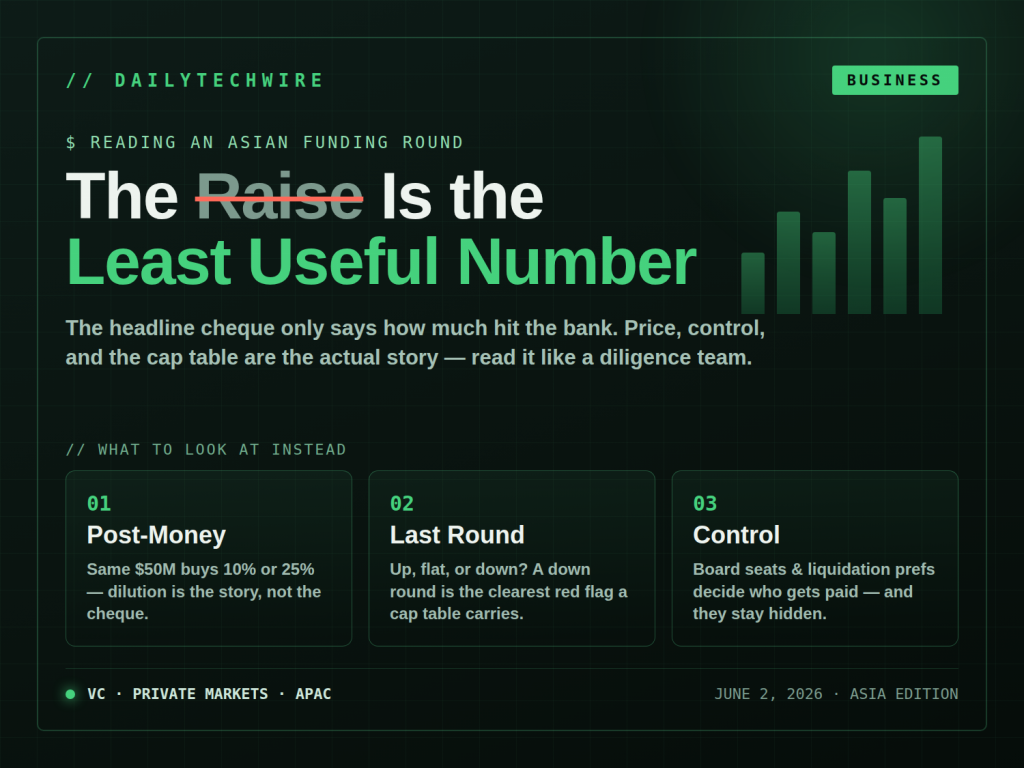
When a startup in Singapore, Jakarta, or Bengaluru announces a fresh round, the headline number is the least useful figure in the release. The dollar amount raised tells you how much capital entered the bank account. It says nothing about the price paid for it, who now controls the company, or whether the deal looks defensible against comparable businesses.
For analysts, the work begins where the press release ends. This is a framework for reading an Asian funding round the way a diligence team would, with the caveat that public announcements rarely disclose enough to complete the picture. Where the data is missing, the right response is to flag the gap, not to fill it with assumption.
The number that matters is post-money valuation, not the raise
A $50 million raise means very different things depending on the price. At a $500 million post-money valuation, the new investors took roughly 10 percent of the company. At a $200 million post-money, the same $50 million bought 25 percent. The dilution to existing shareholders is the story, and it is determined by valuation, not by the size of the cheque.
The first question is therefore the multiple. If a company is raising at a valuation that implies 30 times annual recurring revenue while comparable listed peers trade at 6 to 8 times EV/sales, the gap needs an explanation. Faster growth, higher gross margin, or a larger addressable market can justify a premium. The absence of any such justification is itself a signal.
Compare the round to the last round, not just to peers
The second reference point is the company's own prior round. A valuation that rises is the default expectation. A flat round, where the new valuation matches the old, suggests the company raised because it had to rather than because demand pulled the price up. A down round, where the new post-money sits below the previous one, is the clearest red flag a cap table can carry. It dilutes early backers, can trigger anti-dilution provisions, and often signals that growth fell short of the plan funded by the earlier capital.
Many Asian growth-stage companies raised at elevated valuations in 2021 and 2022. Rounds closing now against those marks deserve particular scrutiny, because the comparison is not to a peer but to the company's own recent past.
Read the cap table for control, not just ownership
Ownership percentages are visible. Control provisions usually are not. The terms that govern board seats, liquidation preferences, and protective rights sit in the shareholders' agreement, which is rarely public for private companies. A lead investor taking a board seat is standard. A liquidation preference above 1x, or a participating preference, changes who gets paid first in an exit and by how much. These structures can leave founders and common shareholders with far less than their headline ownership suggests if the eventual exit price is modest.
When a release names a lead investor and the size of the round but omits the post-money valuation entirely, that omission is the most informative part of the announcement.
The Asia capital-flow context
The direction of capital matters as much as the deal itself. Late-stage funding in the region has historically leaned on a mix of regional sovereign and growth funds alongside global crossover investors who allocate to private rounds during periods of cheap capital and retreat when public markets tighten. The identity of the lead investor signals which pool a round is drawing from. A round led by a strategic corporate investor implies a different rationale, often supply-chain or distribution access, than one led by a financial sponsor pricing for return.
For companies eyeing a public listing, the cap table assembled now constrains the options later. Lock-up arrangements, the presence of investors who will want liquidity, and the valuation set in the final private round all shape what an eventual IPO filing has to clear.
What the press release will not tell you
The figures that determine whether a deal is sound are usually absent from the announcement: burn rate and runway, gross margin, net revenue retention, and the customer acquisition cost relative to lifetime value. A round that extends runway by 30 months at a sustainable burn is a different proposition from one that buys 12 months at a burn that is accelerating.
The discipline, then, is to treat the announcement as a starting hypothesis rather than a conclusion. Until the underlying unit economics and the full terms are visible, the honest assessment of most funding rounds is that the deal is unpriceable from the outside. That is not a flaw in the analysis. It is the accurate reading.