Rust, TypeScript, and Go RFCs Signal Where Each Language Is Headed Next
Active RFCs across Rust, TypeScript, and Go reveal three languages spending their design budget on the same scaling pain points from different angles.
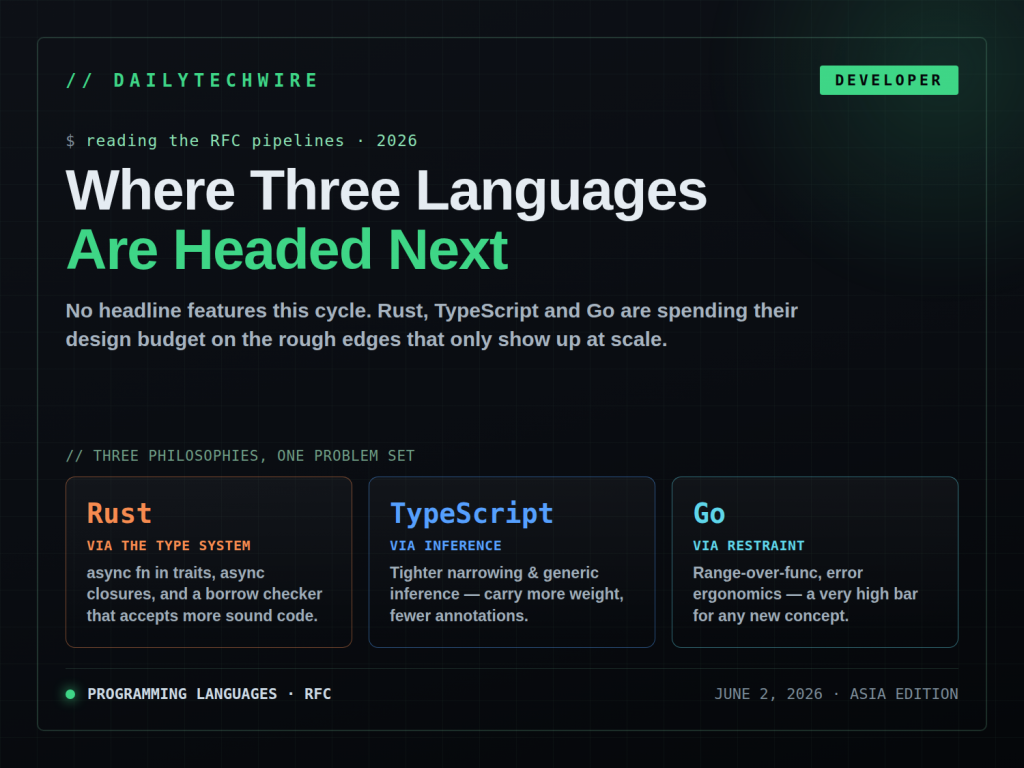
The RFC pipelines for Rust, TypeScript, and Go are where breaking changes and ergonomic shifts get argued out before they reach a release. Reading the active proposals across all three this cycle, a pattern emerges: each language is spending its design budget on the rough edges that show up at scale, not on new headline features.
With no specific RFC numbers or merge dates to point to here, what follows is a read on the categories of work each community is debating, and why they matter if you ship code in these languages.
Rust: chipping away at async and the borrow checker's blind spots
Rust's RFC process remains the most formal of the three, and most of the friction lives in the same place it has for years: async ergonomics and the parts of the type system the borrow checker still rejects despite being provably safe.
The recurring themes worth watching are async closures and the long tail of work needed to make async fn in traits behave the way synchronous code does. If you have written an async trait method and reached for the async-trait macro to get around the missing native support, you already know the cost: heap allocation per call and a Box<dyn Future> you did not ask for. The direction of travel is toward closing that gap so the macro becomes unnecessary, but the trade-offs around object safety and dyn compatibility are exactly why this has taken multiple RFCs.
The other cluster is around the borrow checker accepting more programs that are already sound. Work in this area tends to be invisible until it lands, then it quietly removes a clone() you used to need. None of this is a breaking change in the semver sense; it is the opposite, code that did not compile starts to.
TypeScript: the type system keeps absorbing runtime patterns
TypeScript's proposal flow is less about a formal RFC repo and more about issues and design meeting notes, but the shape of the debate is consistent. The pressure is on the type system to model patterns that JavaScript developers already write, without forcing a refactor.
The themes that keep coming up are tighter control flow narrowing, better inference for generic functions where you currently have to annotate, and the ongoing question of how much of the ECMAScript type-annotation proposal (the "types as comments" line of work) should influence the language's own direction. The latter matters because if runtimes ever execute TypeScript-style annotations directly by stripping them, the gap between what the type checker allows and what the runtime ignores becomes a correctness surface, not just a convenience.
For anyone maintaining a large monorepo, the inference work is the one with real payoff. Every place the compiler infers a type instead of demanding an annotation is a place a refactor does not break. The cost is compiler complexity and, occasionally, inference that is too clever to debug when it picks the wrong type.
Go: deliberately slow, and proud of it
Go's proposal process is the most conservative by design, and the proposals reflect a language that treats every addition as a liability. Generics landed and the community is still working through where they actually belong versus where they add ceremony.
The active discussions worth tracking are refinements to the iterator and range-over-function support, error handling ergonomics (a topic that has consumed and rejected more proposals than almost any other in Go's history), and standard library additions that follow established patterns rather than introduce new ones. Go's bar for a language change is whether the absence causes real pain at scale, and the rejection rate on error-handling syntax proposals shows how high that bar sits.
The trade-off Go makes explicitly is that it will accept verbose, repetitive code over a language feature that adds a concept every reader has to learn. That is a defensible position for a language whose pitch is fast onboarding and readable code at large team size, even when it frustrates developers coming from more expressive languages.
The convergence worth noting
Three languages, three philosophies, and yet the design energy is pointed at overlapping problems: making concurrent and async code less awkward, making the type system carry more weight without more annotation, and removing friction that only shows up once a codebase is large.
Rust attacks it through the type system and zero-cost abstractions, TypeScript through inference and gradual typing, Go through restraint. If you work across all three, the practical takeaway is that none of these RFC cycles is promising a dramatic new capability. They are promising that the code you already write gets a little less painful, which is usually the more honest kind of progress.
The specifics, RFC numbers, target releases, and exact migration paths, are worth tracking directly in each project's proposal repository, since the details shift between design meetings and the language teams reserve the right to defer or reject anything still under discussion.