Handling Critical CVEs: Why Your Migration Path Matters as Much as the Patch
A critical CVE patch is the easy part. Whether you can upgrade without breaking production depends on the migration path the fix ships in.
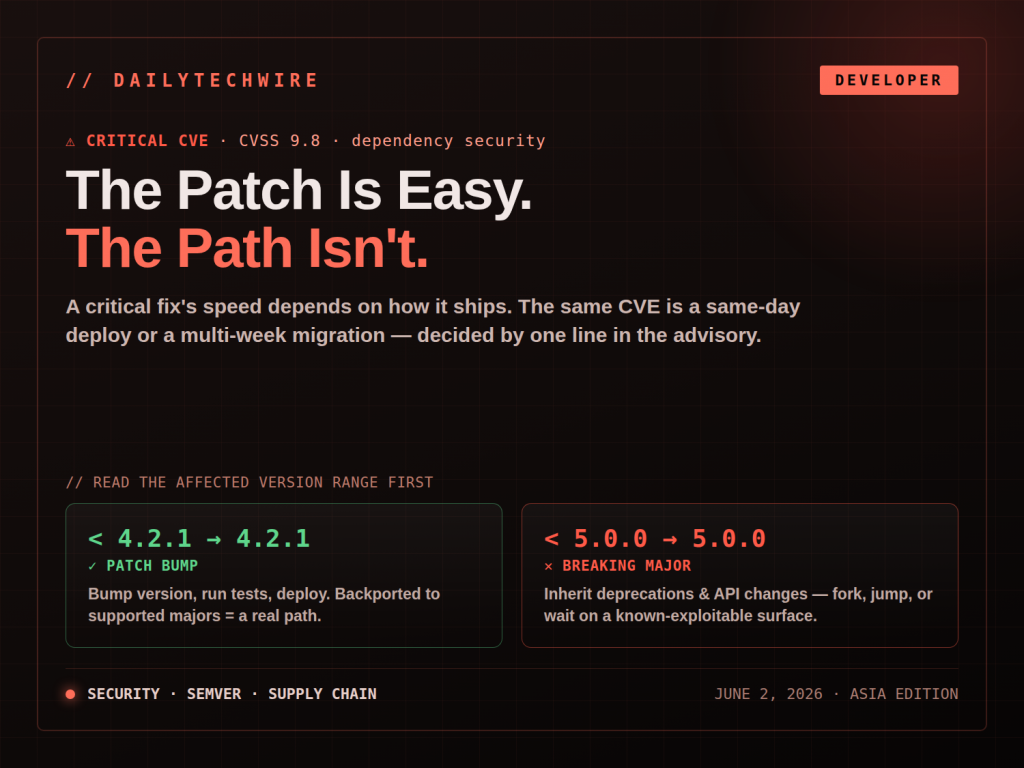
When a critical CVE lands in a dependency you ship to production, the patch itself is rarely the hard part. The hard part is the migration path: whether the fix arrives as a clean patch release, or whether it's bundled into a major version that drags breaking changes along with it.
This distinction decides how fast a team can respond. A CVSS 9.8 fixed in a patch-level release under semver means you bump a version, run your test suite, and deploy. The same fix shipped only in the next major version means you inherit a deprecation list, possible API signature changes, and a regression-testing cycle before anything reaches production.
The patch-only-in-next-major problem
The friction shows up when maintainers backport a security fix to current releases but leave the more invasive change in an unreleased major. Teams pinned to an older major then face a choice: wait for a backport that may never come, fork and patch internally, or take the jump to the new major and absorb every breaking change at once.
None of these is free. Forking shifts the maintenance burden onto your team indefinitely. Jumping a major version under deadline pressure is how regressions reach production. Waiting leaves a known-exploitable surface open.
This is why the structure of a release matters. A maintainer who backports a security fix to all supported majors gives downstream teams an actual migration path. A maintainer who couples the fix to a breaking change forces a larger decision under worse conditions.
Reading the advisory before the changelog
The first useful signal is the affected version range. An advisory that lists < 4.2.1 with a fix in 4.2.1 is a patch bump. One that lists < 5.0.0 fixed in 5.0.0 is a migration. The second case demands you read the major's breaking-change notes before you touch anything.
The second signal is whether a workaround exists independent of the upgrade. Many advisories document a configuration change, a disabled feature flag, or an input filter that closes the vulnerability without a version bump. That buys time to schedule the upgrade properly rather than rushing it.
For transitive dependencies, the range gets harder to reason about. A CVE in a package three levels deep may be pinned by an intermediate dependency that hasn't released a compatible version yet. Lockfile overrides (npm overrides, Yarn resolutions, Cargo [patch]) can force the patched version into the tree, but only if the patched version is API-compatible with what the intermediate package expects. When it isn't, you're back to waiting on the chain to update.
Migration mechanics that reduce risk
When the fix does require a major jump, a few practices keep the blast radius small.
Upgrade in isolation. Move the affected dependency in its own commit, not as part of a broader version sweep. If something breaks, the bisect is trivial.
Lean on type checking where the language allows it. In a type-safe codebase, a major version that changes API signatures will surface most breakages at compile time rather than at runtime. That converts a class of production incidents into build failures, which is the cheaper place to find them.
Stage the rollout. A known-exploitable CVE is a reason to move fast, not a reason to skip canary deployment. Watching p95 latency and error rates on a fraction of traffic before a full rollout catches the regressions that test suites miss.
The structural takeaway
The teams that respond to critical CVEs quickly are usually the ones that kept their dependencies close to current before the disclosure. The cost of being several majors behind is paid in full on the day a fix only ships forward. Staying within one major of upstream turns most security responses into a patch bump, which is the difference between a same-day deploy and a multi-week migration under pressure.
Dependency hygiene isn't a security control on its own. It's what determines whether your migration path exists when you need it.