Asia’s Cross-Border Capital Flows Are Repricing Risk, Not Retreating
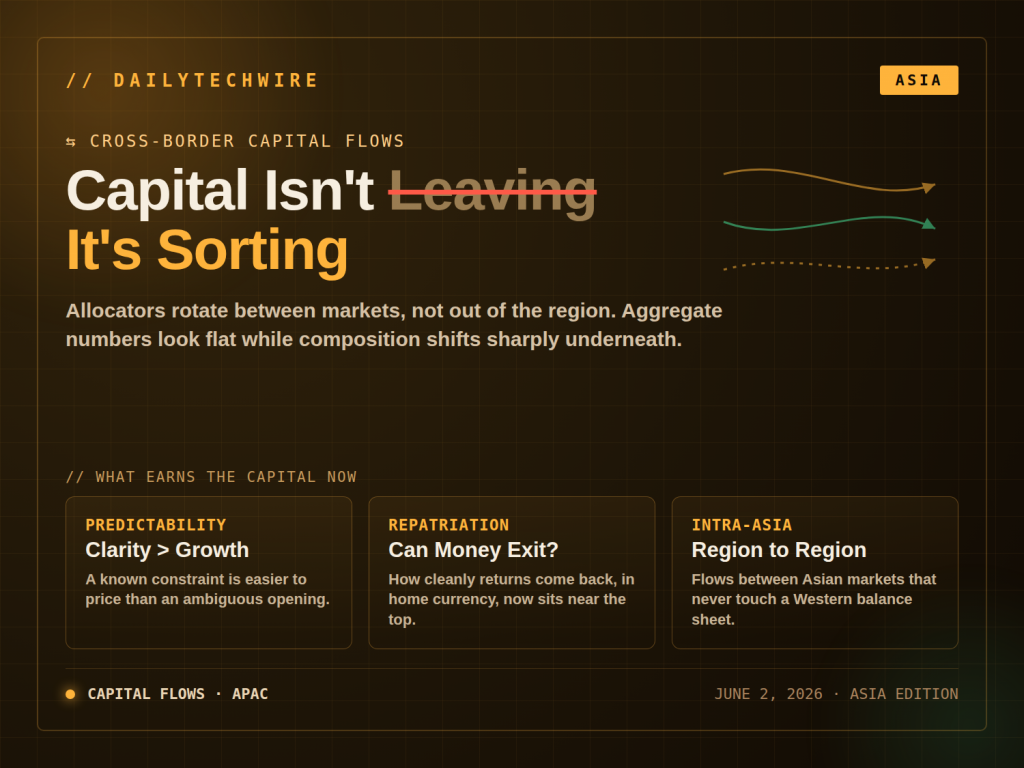
Cross-border capital into and out of Asia is not retreating but sorting, with regulatory clarity and repatriation predictability now outweighing headline market size.
In a Singapore boardroom, a fund manager describes the new diligence checklist for any deal touching Indonesia or India: not just unit economics, but how cleanly capital can move back out. That second question, once an afterthought, now sits near the top.
Cross-border capital flows into and out of Asia are not contracting so much as becoming more discriminating. After a decade in which global allocators treated the region as a single growth trade, the flows of the past two years tell a more fragmented story. Money is still moving, but it is moving along narrower channels shaped by repatriation rules, currency exposure, and the specific regulatory posture of each jurisdiction.
The capital is not leaving, it is sorting
The simplest reading of recent flow data, that foreign capital is pulling back from Asia, misses what is actually happening on the ground. Allocators are rotating between markets rather than exiting the region wholesale. A position trimmed in one country often reappears in another, redirected by interest rate differentials, election cycles, or a single new rule on profit repatriation.
This sorting behaviour explains why aggregate numbers can look flat while individual markets swing sharply. A regional fund can hold its total Asia exposure steady while completely reshaping what sits inside that exposure. The headline tells you little; the composition tells you everything.
For founders raising capital, the practical consequence is that the country you build in now matters as much as the company you build. The same revenue profile commands different terms depending on how predictably an overseas investor can eventually realise a return in their home currency.
Regulatory clarity has become a currency of its own
The distinguishing feature of the markets attracting durable capital is not always growth. It is predictability. Investors are placing a premium on jurisdictions where the rules governing foreign ownership, data, and repatriation are written down and applied consistently, even when those rules are restrictive.
A clearly restrictive regime is, paradoxically, easier to underwrite than an ambiguous open one. Capital can price a known constraint. It struggles to price the possibility that a constraint might appear after the money is committed. This is the nuance that flow-chasing coverage tends to overlook: the friction that deters investment is uncertainty, not regulation itself.
Local partnership structures, joint ventures, domestic holding entities, and licensing arrangements with established players, have re-emerged as the default rather than the workaround. They are no longer seen primarily as a compliance burden but as the mechanism that makes a deal financeable in the first place.
Outbound flows tell the other half of the story
Capital leaving Asia is also reshaping. Regional corporates and sovereign-linked investors continue to deploy abroad, but the destinations and rationales have shifted. Some of this is diversification, spreading exposure beyond home markets. Some is strategic, securing supply chain footholds or technology access through minority stakes and acquisitions.
What is notable is that intra-Asia flows, capital moving between Asian markets rather than into or out of the region, form a growing share of the total. A company headquartered in one Asian market expanding into a neighbour is now a routine cross-border transaction that never touches a Western balance sheet. These flows rarely make global headlines, but they are increasingly where the volume sits.
What to watch next
The deciding variables for the next phase are concrete rather than sentimental. Currency stability against the dollar will govern how much hedging cost erodes returns. The pace and consistency of regulatory rule-making will determine which markets earn the predictability premium. And the depth of local capital, the degree to which domestic investors can co-invest alongside foreign money, will shape how much external capital each market can absorb without distortion.
The region is not a single trade and arguably never was. The more accurate frame is a set of distinct markets, each pricing its own balance of opportunity and friction, with capital flowing toward whichever side of that balance looks most legible at any given moment.