Data Localization in Southeast Asia: How Vietnam’s Decree 13 and Indonesia’s KOMINFO Rules Diverge
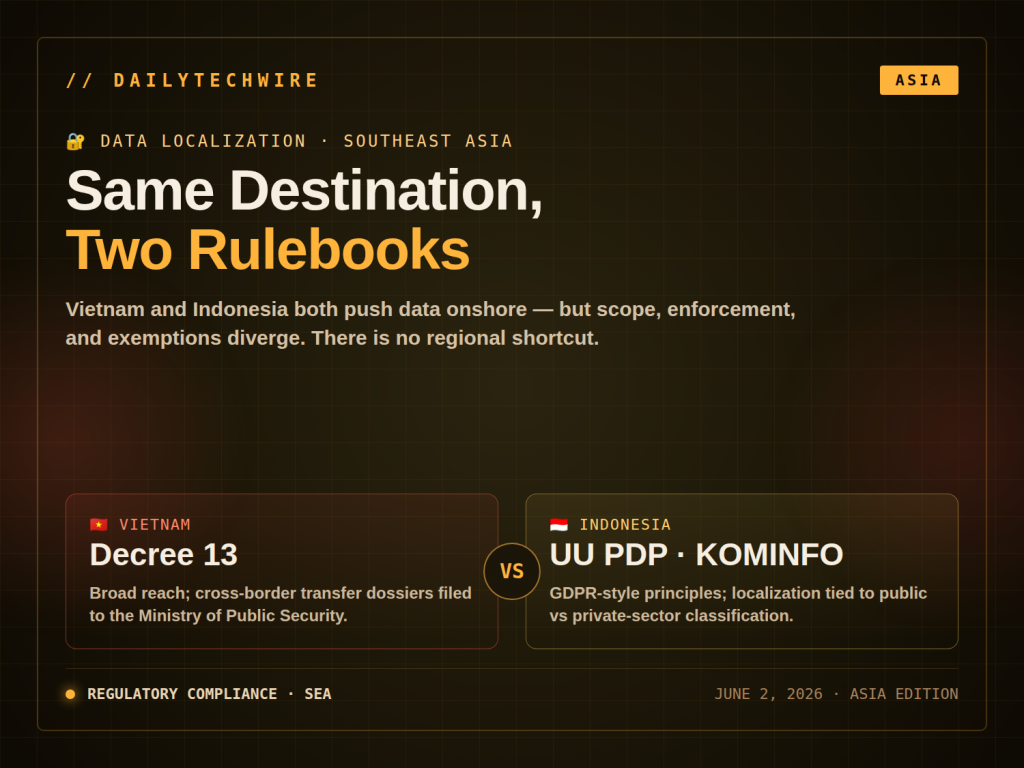
Vietnam's Decree 13 and Indonesia's data rules both push localization, but their scope, enforcement, and exemptions differ in ways that reshape regional compliance.
In a Ho Chi Minh City co-working space last year, a compliance officer at a mid-sized fintech told a recurring story among regional operators: the company had budgeted for one set of data rules across Southeast Asia, only to discover that Vietnam and Indonesia demanded almost entirely different things. That gap, more than any single regulation, defines what businesses face when they handle personal data across the region.
Vietnam's Decree 13 on Personal Data Protection took effect on 1 July 2023, becoming the country's first comprehensive framework dedicated to personal data. It sits alongside the earlier Law on Cybersecurity, which had already introduced data localization expectations for certain service providers. Decree 13 sets out obligations around consent, data subject rights, the handling of sensitive data, and the cross-border transfer of personal data, including a requirement to prepare and submit transfer impact assessment dossiers to the Ministry of Public Security.
Indonesia took a different route. Its Personal Data Protection Law (UU PDP), passed in 2022, established a more principles-based regime closer in structure to the EU's General Data Protection Regulation, with a transition period running through 2024. Separately, localization-style requirements have been driven through government regulations and ministerial rules historically associated with KOMINFO, the communications ministry now reorganized under the country's broader digital governance restructuring. The distinction matters: in Indonesia, the question of whether data must physically stay onshore has long been tied to whether an operator is classified as serving the public sector or the private sector.
Where the two regimes actually differ
The most consequential difference is scope. Vietnam's framework reaches broadly into how companies process and transfer personal data, and the cross-border transfer dossier requirement under Decree 13 has no clean equivalent in most Western regimes. Companies operating in Vietnam have reported uncertainty over how strictly the dossier and localization expectations are enforced in practice, a recurring theme since the decree took effect.
Indonesia's approach has historically been more permissive for private-sector operators on the question of physical data location, while applying tighter localization expectations to public-sector and strategic electronic systems. The UU PDP itself focuses on protection principles and data subject rights rather than mandating where servers must sit.
For a regional platform, the operational implication is concrete. A single architecture decision, such as where to host a primary database, can satisfy one jurisdiction's reading while triggering a separate filing or storage obligation in another.
The compliance cost is not the headline number
Much of the public discussion around localization fixates on infrastructure spending: the assumption that firms must build or rent local data centers. The harder cost is governance. Mapping data flows, classifying sensitive categories, preparing jurisdiction-specific transfer documentation, and maintaining records that satisfy multiple regulators at once requires legal and engineering coordination that smaller operators often underestimate.
This is where the divergence between Vietnam and Indonesia becomes a strategic question rather than a checkbox. A company can build to the strictest common denominator, accepting higher cost for simplicity, or it can localize its compliance posture per market, accepting complexity for efficiency.
Why this is a regional story, not a national one
Vietnam and Indonesia are not outliers. Across Southeast Asia, governments have moved toward asserting sovereignty over data generated within their borders, motivated by a mix of security concerns, law enforcement access, and economic interest in domestic digital infrastructure. The result is a patchwork rather than a harmonized standard, in contrast to the EU's single GDPR baseline.
For companies building across the region, the practical reality is that there is no regional shortcut. Decree 13 and the Indonesian framework represent two distinct philosophies arriving at a similar destination: data generated locally increasingly comes with local obligations. The companies that handle this well treat regulatory mapping as a core engineering input, not an afterthought handled by counsel at launch.