India’s UPI Crosses Into the Mainstream, and Fintech IPOs Are Lining Up Behind It
UPI has become daily infrastructure for hundreds of millions of Indians. Now the fintechs built on top of it are testing public markets, under a watchful regulator.
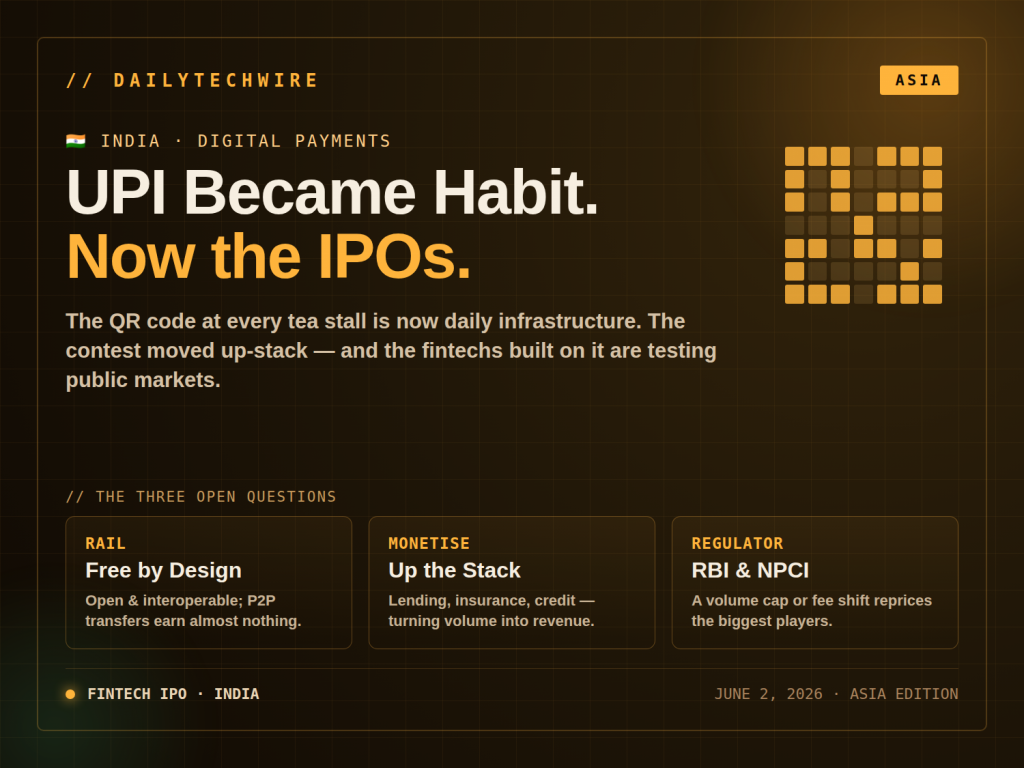
Walk into a roadside tea stall in Bengaluru or a vegetable market in Lucknow, and the laminated QR code taped to the counter has become as common as the cash box it is steadily replacing. That small square is the visible edge of Unified Payments Interface, the real-time payments rail that has reshaped how money moves in India over the past several years.
UPI was built by the National Payments Corporation of India (NPCI), a not-for-profit entity backed by the country’s banks and overseen by the Reserve Bank of India. Its design choice mattered: it is an open, interoperable layer that any bank or licensed app can plug into, rather than a closed network owned by a single payments company. That structure is why a user on one app can send money instantly to someone on a completely different app, with no fee on the typical person-to-person transfer.
Why the rail, not the apps, is the story
The usual framing in international coverage treats UPI as a payments app phenomenon. The more accurate read is infrastructural. UPI sits underneath the apps, which means the competitive action has moved up the stack. The dominant consumer interfaces, including PhonePe, Google Pay, and Paytm, compete on user experience, merchant relationships, and cross-selling rather than on owning the underlying transfer mechanism.
That distinction shapes the business problem facing every fintech in the country. Because core peer-to-peer payments generate little to no direct revenue, the apps that grew on UPI have spent recent years trying to convert payment volume into something that pays: lending, insurance distribution, wealth products, merchant services, and credit on UPI. The strategic question for the sector is whether the engagement built on free transfers can be monetised without alienating users or running into regulatory friction.
The regulatory hand is always in frame
No account of Indian fintech is complete without the Reserve Bank of India, which has been an active and sometimes abrupt regulator. The RBI has periodically tightened rules on digital lending, data handling, and the structure of partnerships between fintechs and licensed banks. NPCI, for its part, has long signalled discomfort with market concentration, floating the idea of a cap on how much UPI volume any single app can control. A cap of that kind, if enforced firmly, would directly affect the valuation logic of the largest players.
This regulatory context is not a footnote to the IPO story. It is central to it. Public market investors pricing an Indian fintech are pricing exposure to a regulator that has shown willingness to change the rules of the road, sometimes with limited notice.
The IPO queue
India’s listing market has given fintech founders a credible domestic exit, a meaningful shift from the era when the assumed endgame was a foreign acquisition or an overseas listing. Paytm’s parent, One97 Communications, made the first large fintech debut on Indian exchanges and saw its shares fall sharply after listing, a chastening reference point that later candidates have studied closely. PhonePe, majority owned by Walmart, has publicly moved toward a domestic listing and redomiciled to India, a step that carries tax cost but aligns the company with where its users and regulators sit.
The broader pipeline includes insurance and lending-focused fintechs that have leaned away from pure payments toward revenue lines investors can underwrite. The pattern echoes what happened in other markets after a payments boom: the rail becomes a utility, and the durable businesses are the ones that layer credit and financial products on top of it.
What to watch
The near-term signals worth tracking are concrete. Whether NPCI imposes and enforces a volume cap. Whether the RBI’s stance on UPI transaction fees shifts, since a sustainable monetisation model for the rail itself remains unresolved. And whether the next wave of fintech listings prices closer to profitability than to growth-at-any-cost, given how the first generation of debuts performed.
UPI has already done the hard part, which is becoming habit. The open question is whether the companies built around it can turn habit into a business that public investors are willing to hold.