What Peer-Reviewed Work Actually Shows About Quantum Error Correction in 2024
Below-threshold error correction has reached peer-reviewed hardware demonstrations, but qubit coherence still sets the resource budget for fault tolerance.
Quantum computing's central engineering problem is no longer abstract: physical qubits are noisy, and useful computation requires logical qubits stable enough to run long circuits. The field's published literature over the past two years has shifted from proposing error-correction schemes to demonstrating them on real hardware, which is the more meaningful test.
The threshold that matters
Error correction works by spreading the information of one logical qubit across many physical qubits, then measuring auxiliary qubits to detect errors without collapsing the data. The theoretical promise is that, below a certain physical error rate, adding more physical qubits per logical qubit drives the logical error rate down rather than up. Above that threshold, more qubits only add more noise.
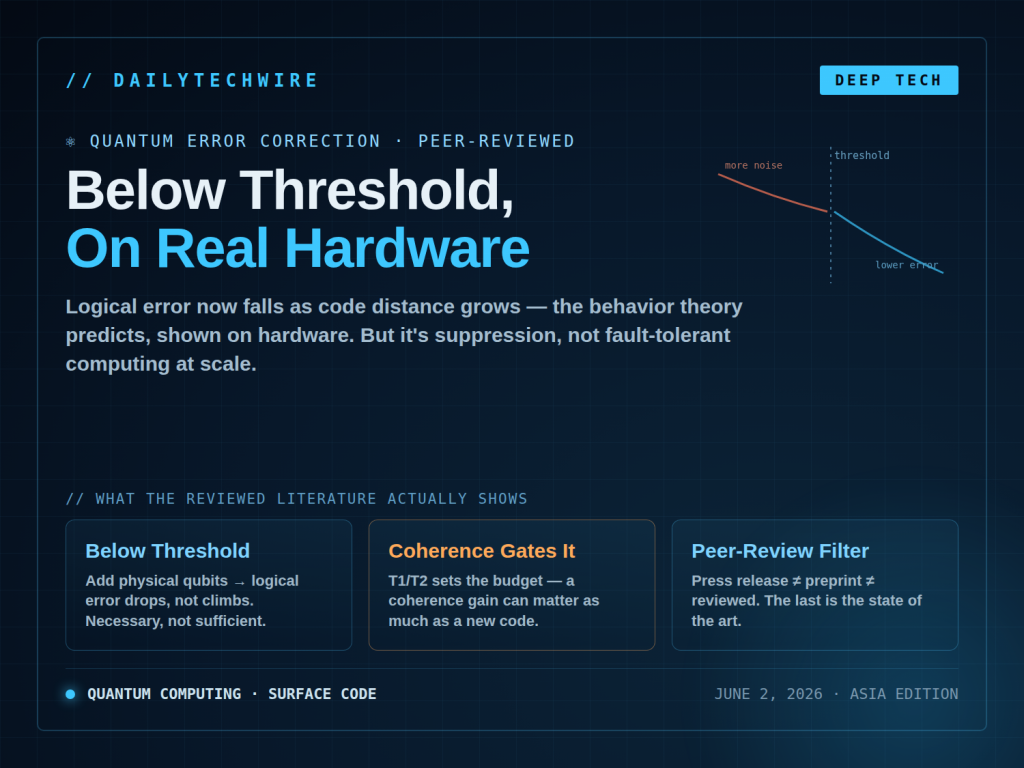
Reaching the "below-threshold" regime has been the long-standing milestone, because it is the point at which scaling becomes a path to lower error rather than an accumulation of it. Peer-reviewed demonstrations using the surface code, the most studied architecture for superconducting and neutral-atom systems, have reported logical error rates that decrease as code distance increases. That is the behavior the theory predicts, and observing it on hardware is qualitatively different from simulating it.
The caveat that belongs in every such result: these are demonstrations of suppression, not of fault-tolerant computation at scale. A logical qubit that holds its state longer than its constituent physical qubits is a necessary condition for practical machines, not a sufficient one.
Coherence is still the gating constraint
Underneath every error-correction result sits qubit coherence time, the interval during which a qubit retains its quantum state before decohering. T1 (energy relaxation) and T2 (dephasing) are the standard metrics, measured in microseconds for most superconducting qubits and substantially longer for trapped-ion and some neutral-atom platforms.
Coherence sets the budget. Error correction can only catch errors faster than they accumulate if the underlying gates and measurements are fast and accurate relative to the decoherence rate. Improvements in materials, fabrication, and qubit design that extend coherence times feed directly into lower physical error rates, which in turn lower the number of physical qubits needed per logical qubit. The two problems are not separable.
This is why a published gain in coherence time is often as consequential as a new code: it changes the resource overhead. Estimates for the number of physical qubits required per fault-tolerant logical qubit vary widely across the literature and depend heavily on assumed error rates, which is precisely why peer-reviewed measurements of those rates carry more weight than roadmap projections.
Why the peer-review filter matters here
Quantum is a field where corporate announcements routinely outrun verification. A press release claiming a milestone, an arxiv preprint, and a paper that has cleared review are three different levels of evidence. The distinction is not pedantic. Reviewers check whether reported error rates account for correlated noise, whether the logical-qubit comparison is fair, and whether the claimed scaling holds across multiple code distances rather than a single favorable point.
For anyone tracking the field, the practical filter is straightforward: separate what has appeared in reviewed venues from what has only been announced. The former is where the actual state of the art lives.
What to watch next
The near-term questions are concrete. Can below-threshold operation be sustained across more logical qubits simultaneously, not just one. Can coherence improvements hold as systems scale, rather than degrading from crosstalk and control complexity. And can the measurement and decoding electronics keep pace, since real-time decoding of error syndromes is itself an unsolved engineering bottleneck at large qubit counts.
None of these has a published answer at full scale yet. The trajectory in the reviewed literature is encouraging on each, but the gap between a demonstrated logical qubit and a fault-tolerant machine running useful algorithms is measured in orders of magnitude, not increments.